


You have ten grand. In the world of venture capital, that is pocket change. In the real world of a scrappy startup, it is a lifeline. Most founders blow this first injection of cash on “culture.” They buy fancy bean bags, a $2,000 espresso machine, or branded hoodies nobody asked for.
That is how you fail.
If you want to survive the first year, you invest in the plumbing. You spend that money on the invisible things that make your team fast and your customers trust you. Stop looking at the furniture catalog. Look at your stack.
Cloud Infrastructure & Hosting
Stop over-provisioning. I once saw a seed-stage startup burning $2,000 a month on AWS instances they didn’t even use. They were paying for a skyscraper when they only had three employees.
Spend your first few thousand dollars on a managed hosting environment that scales with you, not a complex web of servers you have to babysit. Get a pro to set up your environment so it actually loads in under two seconds. A one-second delay in page load time can tank conversions by 7 percent. Do the math. If you lose $700 for every $10,000 in sales because your site is slow, your “cheap” hosting is actually costing you a fortune.
If you are running a service-based business or a storefront, your priority shouldn’t be server maintenance; it should be high-end performance and conversion. This is where hiring a Wix partner agency makes the difference. Rather than DIY-ing a clunky template, you’re investing in professional web design services that ensure your site is visually elite and optimized to load in under two seconds.
DevOps & Automation
Your lead engineer should not be manually deploying code at 2 AM. That is a recipe for a broken product and a burnt-out hire.
Invest in basic CI/CD (Continuous Integration/Continuous Deployment) tools. Automation is the only way to stay lean. Spend $1,500 here to make sure every update is tested and shipped without a human clicking “upload.” I worked with a team that automated their deployment pipeline and reclaimed 10 hours of dev time per week. At $100 an hour for a senior dev, that is $1,000 in “found” money every single week.
Security & Compliance
Nobody likes talking about security until their database ends up on a dark web forum. You do not need a million-dollar cyber defense suite. You do need the basics.
Spend $1,000 on a solid password manager for the team and an automated backup system. If your lead engineer spills coffee on his laptop and you lose three weeks of code, you just burned way more than $10k in labor. Get your SOC2 readiness started early if you plan on selling to enterprise clients. It is a boring “tax” that pays off when you land your first six-figure contract.
WiFi Solutions for Offices
I once consulted for a small dev shop in a trendy loft. They had beautiful exposed brick and the worst internet I have ever seen. Every time the guy in the corner used the microwave, the Zoom calls dropped. Productivity plummeted 25 percent every afternoon. They were literally paying people to sit around and wait for pages to load.
Do not be that guy.
Spend a chunk of that $10k on enterprise-grade wifi solutions for offices. Forget the router you bought at a big box store. You need a mesh system that handles fifty devices without breaking a sweat. You need dedicated access points. If your team spends half their day staring at a spinning loading wheel, you aren’t running a business. You are running a digital waiting room. A solid network setup might cost you two grand, but it pays for itself in a month of recovered billable hours.
Database & Data Systems
Your data is a mess. Admit it.
You probably have customer info scattered across three spreadsheets and a half-configured CRM. Spend $1,000 of your budget to centralize this. Pick a scalable database and stick to it. I’ve seen startups spend $5k later just to clean up the “junk data” they collected in the first six months. Do it right the first time. Set up clear schemas and automated backups. Future you will thank current you when it is time to run a real report.
Internal Tools & Productivity
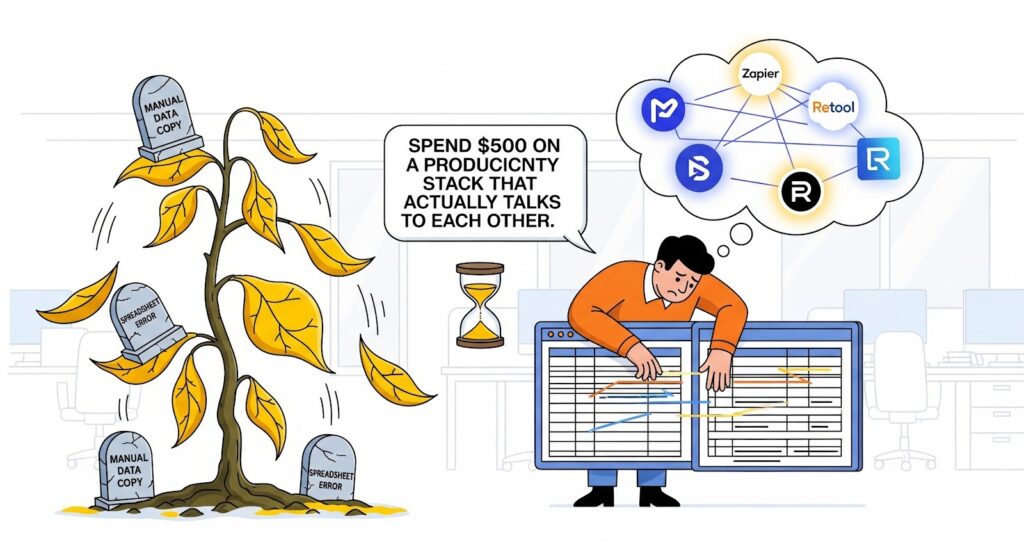
Every time a human has to manually copy data from one spreadsheet to another, a little bit of your startup dies. It is slow. It is prone to errors. It is boring.
Use tools like Zapier or Retool to bridge the gaps between your apps. Spend $500 on a “productivity stack” that actually talks to each other. If your sales tool doesn’t talk to your accounting tool, you are wasting time. Time is the only resource you can’t buy more of.
Analytics & Monitoring
If you don’t know why your site went down, you aren’t running a professional operation. You are guessing.
Set up basic monitoring tools. You need to know when your server CPU spikes or when your checkout page throws an error. Spend the last $500 of your budget on an analytics suite that tells you where your users are dropping off. Don’t guess. Measure. One startup I advised found a bug in their mobile sign-up flow using basic heatmaps. Fixing it doubled their user growth overnight.
The Bottom Line
That is $10k well spent. It isn’t sexy. You can’t post a picture of a router or a database schema on Instagram and get a thousand likes. But you know what is sexy? A business that doesn’t crash. A team that isn’t frustrated by slow tools. A bank account that grows because your infrastructure actually works.
Stop trying to look like a successful startup. Start acting like a functional business. Fix your infrastructure now or pay for it tenfold in six months.
The choice is yours. Do you want a pretty office or a profitable one?
